Agentic AI Disrupts Traditional Data Security Posture
By Eito Miyamura and Ilia Manolov
Overview
Autonomous AI agents fundamentally challenge traditional security frameworks, particularly Role-Based Access Control (RBAC). Unlike simple chatbots, these agents act independently by chaining tools together to complete tasks, but that capability creates significant data leak risks conventional security systems weren't designed to handle.
Key Problems Identified
RBAC Breakdown
Traditional access controls treat users and their AI agents as a single entity. When an employee gains document access, their agent gains it too. The authors illustrate this with a scenario where "Alice connects her AI assistant to Slack and OneDrive" and inadvertently leaks confidential M&A details to external clients. The system also enables insider threats: a malicious employee could exploit an executive's agent access to retrieve restricted information they personally cannot access.
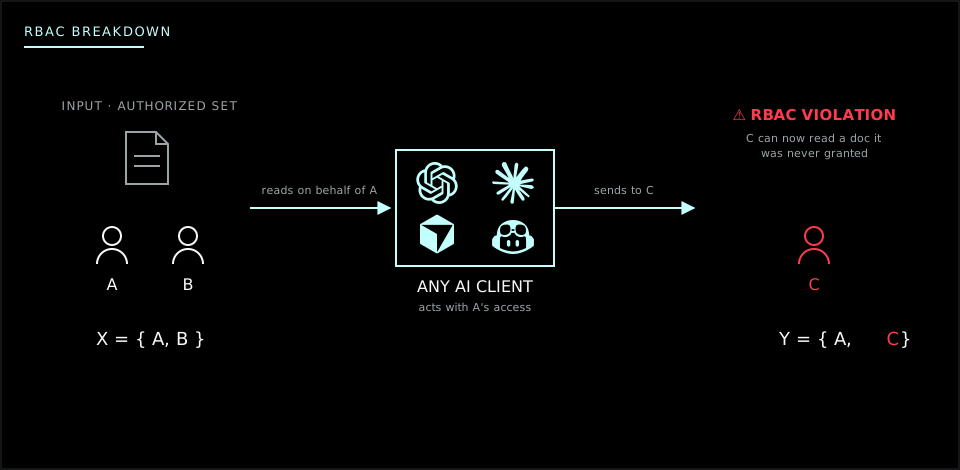
How RBAC breaks down the moment you connect an agent to your documents and email.
Observability Gaps
Security teams face a critical visibility problem. Network monitoring tools capture either low-level traffic or browser activity, missing the middle layer where agents operate. When "Dan in HR uses ChatGPT to process PDFs" while "Elise in Development runs a CI action," security sees scattered API requests without context linking them to specific agent workflows. This delays incident detection and prevents meaningful auditing.
Proposed Solutions
Two-Option Framework
Organizations can either:
- Disable exporting tools (email, messaging, file sharing) company-wide for AI agents
- Deploy agent-aware RBAC systems that monitor and enforce data flows
The Pareto Frontier Approach
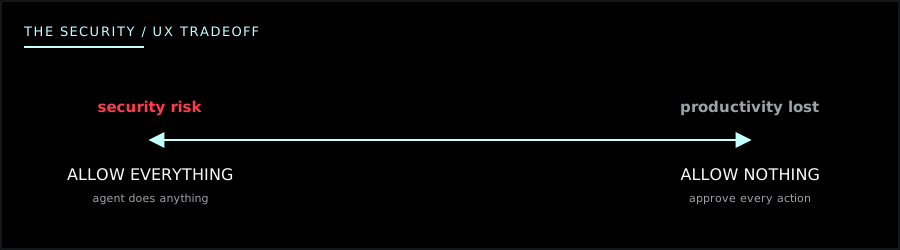
The blunt choice: permissive agents leak data, restrictive agents kill productivity.
Rather than choosing between permissive agents (productivity but security risks) or restrictive ones (secure but limiting), the authors recommend an "agentic gateway," essentially a firewall for agent actions. This centralized layer:
- Whitelists safe operations
- Blocks known attack patterns
- Flags anomalies for review
- Enables automatic execution while maintaining oversight
They note this approach achieves approximately 90% of the security benefits with significantly better user experience than manual approval systems.
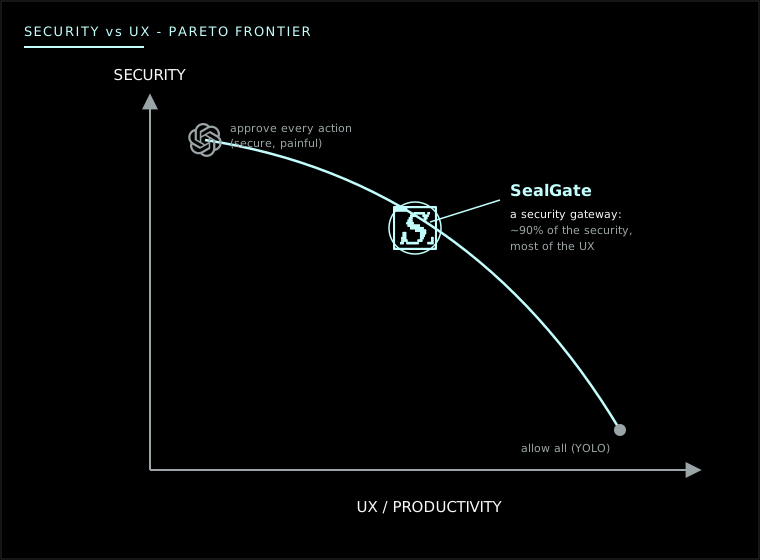
A security gateway sits at the knee of the curve: roughly 90% of the security, most of the UX.
Technical Implementation
SealGate is one implementation of this pattern: an MCP gateway that intercepts every tool call organization-wide, regardless of which AI application an employee uses, creating a unified policy enforcement point and a system of record for post-incident analysis.
Core Takeaway
Organizations cannot simply extend existing human-centric security controls to autonomous agents. They need purpose-built frameworks that acknowledge what makes agents different: their autonomy, their ability to aggregate information across contexts, and their susceptibility to prompt injection attacks. Those frameworks also have to preserve the productivity benefits that make agentic workflows valuable.
Subscribe
New writing on securing agentic AI and MCP, straight to your inbox. No spam, unsubscribe anytime.